Magnetic Mouse Trails
Live previewPerformance varies by device
No account needed to copy or download. Check dependencies and thelicense status before publishing.
<!DOCTYPE html>
<html lang="en">
<head>
    <meta charset="UTF-8">
    <meta name="viewport" content="width=device-width, initial-scale=1.0">
    <title>Magnetic Mouse Trails</title>
    <style>
        body {
            margin: 0;
            overflow: hidden;
            background-color: #0f172a;
        }
        canvas {
            display: block;
            width: 100vw;
            height: 100vh;
        }
    </style>
</head>
<body>
    <canvas id="magneticCanvas"></canvas>
    <script>
        const canvas = document.getElementById('magneticCanvas');
        const ctx = canvas.getContext('2d');
        let width, height;
        let particles = [];
        const config = {
            particleCount: 500, // Reduced for wider compatibility, can handle thousands
            repelRadius: 150,
            returnSpeed: 0.1,
            color: '#38bdf8'
        };
        let mouse = { x: -1000, y: -1000, vx: 0, vy: 0 };
        let lastMouse = { x: -1000, y: -1000 };
        // Idle drift state: lastInputTime is performance.now() of the
        // last real mouse/touch input (-2000 = idle from load). idlePos
        // is the eased autonomous attractor used while idle.
        let lastInputTime = -2000;
        let idleTime = 0;
        let idlePos = { x: -1000, y: -1000 };
        function resize() {
            width = canvas.width = window.innerWidth;
            height = canvas.height = window.innerHeight;
            init();
        }
        class Particle {
            constructor(x, y) {
                this.ox = x; // Origin X
                this.oy = y; // Origin Y
                this.x = x;
                this.y = y;
                this.vx = 0;
                this.vy = 0;
                this.size = Math.random() * 2 + 1;
                // Randomize color slightly around the base blue
                const brightness = Math.floor(Math.random() * 50) + 200;
                this.color = `rgba(56, 189, 248, ${Math.random() * 0.5 + 0.5})`;
            }
            update() {
                // Calculate distance to mouse
                const dx = mouse.x - this.x;
                const dy = mouse.y - this.y;
                const dist = Math.sqrt(dx * dx + dy * dy);
                // Magnetic Repulsion
                if (dist < config.repelRadius) {
                    const force = (config.repelRadius - dist) / config.repelRadius;
                    const angle = Math.atan2(dy, dx);
                    // We push the particle AWAY from the mouse
                    // and add some of the mouse velocity for a "swirl" effect
                    this.vx -= Math.cos(angle) * force * 5 + mouse.vx * force * 0.1;
                    this.vy -= Math.sin(angle) * force * 5 + mouse.vy * force * 0.1;
                }
                // Spring back to origin (magnetic attraction to home base)
                this.vx += (this.ox - this.x) * config.returnSpeed;
                this.vy += (this.oy - this.y) * config.returnSpeed;
                // Friction
                this.vx *= 0.85;
                this.vy *= 0.85;
                this.x += this.vx;
                this.y += this.vy;
            }
            draw() {
                ctx.fillStyle = this.color;
                ctx.beginPath();
                ctx.arc(this.x, this.y, this.size, 0, Math.PI * 2);
                ctx.fill();
            }
        }
        function init() {
            particles = [];
            // Create a grid of particles
            const spacing = 20;
            const cols = Math.floor(width / spacing);
            const rows = Math.floor(height / spacing);
            // Adjust offset to center grid
            const offsetX = (width - cols * spacing) / 2;
            const offsetY = (height - rows * spacing) / 2;
            for (let i = 0; i < cols; i++) {
                for (let j = 0; j < rows; j++) {
                    // Skip some for organic feel
                    if (Math.random() > 0.2) {
                        particles.push(new Particle(offsetX + i * spacing, offsetY + j * spacing));
                    }
                }
            }
        }
        const reducedMotion = matchMedia('(prefers-reduced-motion: reduce)').matches;
        function animate() {
            // Fading trail effect via low opacity clearRect alternative
            ctx.fillStyle = 'rgba(15, 23, 42, 0.3)';
            ctx.fillRect(0, 0, width, height);
            // Idle drift: after 2s without real input, ease the
            // effective attractor along a slow Lissajous path so the
            // dot field stays alive. A real mousemove updates mouse and
            // lastInputTime in the handlers, taking over immediately.
            // Skipped under prefers-reduced-motion (animate() runs a
            // single static frame there anyway).
            if (!reducedMotion) {
                if (performance.now() - lastInputTime > 2000) {
                    idleTime += 0.008;
                    const tx = width * (0.5 + 0.34 * Math.sin(idleTime * 0.9));
                    const ty = height * (0.5 + 0.30 * Math.sin(idleTime * 1.27 + 1.3));
                    if (idlePos.x < -500) { idlePos.x = tx; idlePos.y = ty; }
                    idlePos.x += (tx - idlePos.x) * 0.04;
                    idlePos.y += (ty - idlePos.y) * 0.04;
                    mouse.x = idlePos.x;
                    mouse.y = idlePos.y;
                } else {
                    // Keep the idle attractor at the cursor so the next
                    // idle phase hands off smoothly from its position.
                    idlePos.x = mouse.x;
                    idlePos.y = mouse.y;
                }
            }
            // Calculate mouse velocity for swirling
            mouse.vx = mouse.x - lastMouse.x;
            mouse.vy = mouse.y - lastMouse.y;
            lastMouse.x = mouse.x;
            lastMouse.y = mouse.y;
            for (let i = 0; i < particles.length; i++) {
                particles[i].update();
                particles[i].draw();
            }
            if (!reducedMotion) requestAnimationFrame(animate);
        }
        window.addEventListener('resize', resize);
        window.addEventListener('mousemove', (e) => {
            mouse.x = e.clientX;
            mouse.y = e.clientY;
            lastInputTime = performance.now();
        });
        window.addEventListener('mouseout', () => {
            mouse.x = -1000;
            mouse.y = -1000;
            lastInputTime = -2000;
        });
        // Touch support for mobile interaction
        window.addEventListener('touchmove', (e) => {
            e.preventDefault(); // Prevent scrolling
            mouse.x = e.touches[0].clientX;
            mouse.y = e.touches[0].clientY;
            lastInputTime = performance.now();
        }, { passive: false });
        window.addEventListener('touchend', () => {
            mouse.x = -1000;
            mouse.y = -1000;
            lastInputTime = -2000;
        });
        resize();
        animate();
    </script>
</body>
</html>About this animation
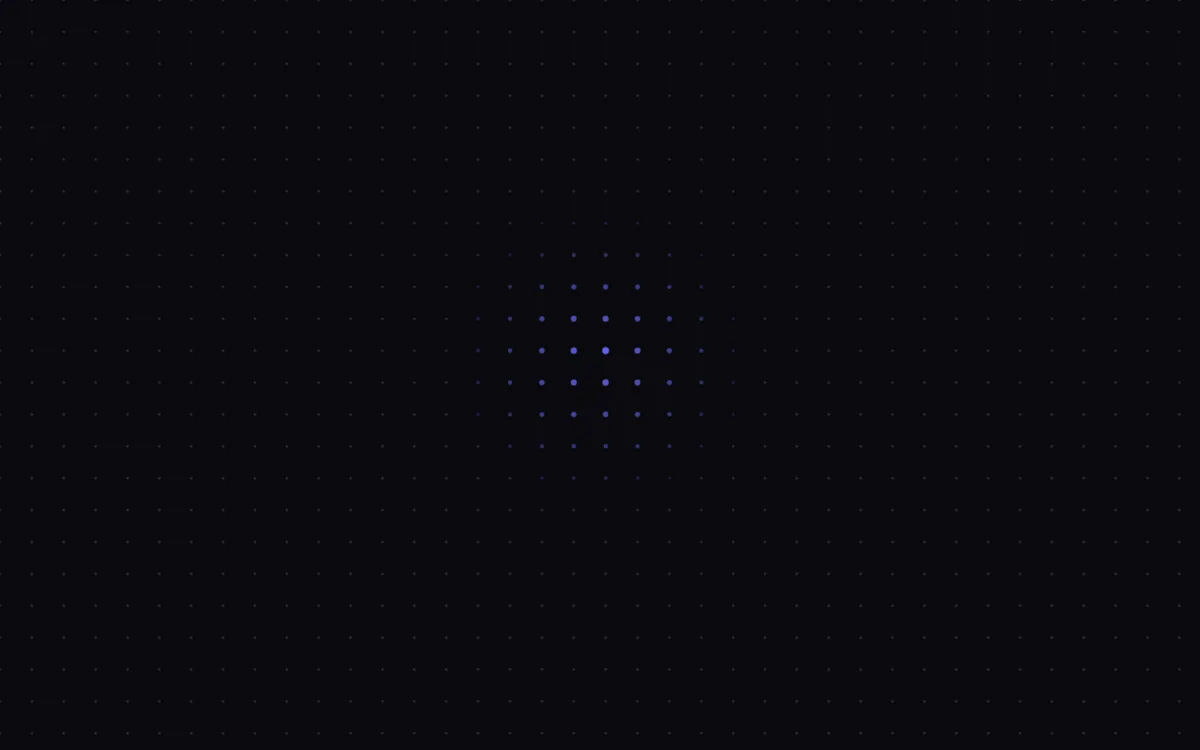
Viscous fluid particles that exhibit magnetic attraction and smooth repulsions based on cursor movement.
Under the hood
Friction & Attraction Physics Vectors
These particles use two distinct physics rules. First: Magnetic repulsion via
Math.atan2(dy, dx) pushes the particle away from the mouse. Second: An elastic attraction variable pulls the particle smoothly back to its original origin point. A low-opacity fillRect across the canvas ensures a gorgeous trailing burn-in effect. After 2 seconds without mouse or touch input, the attractor eases along a slow Lissajous path on its own until real input takes over again.Related